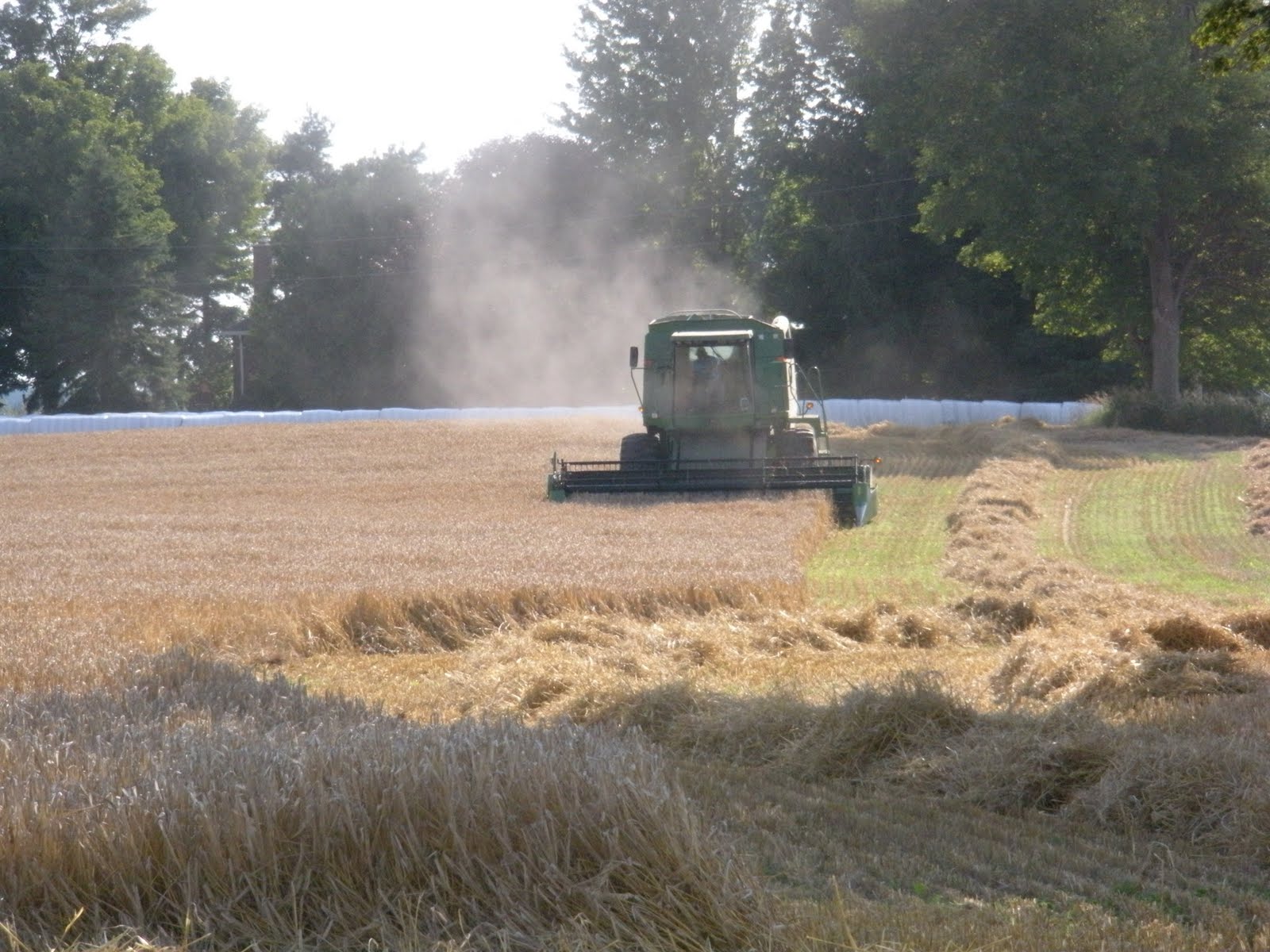
Travelling along one of the back roads on my return from Owen Sound, a nearby city, I was met by several huge machines. I had to pull way off the narrow road so that these harvesters could get past. A bit further along the road I saw where they'd been coming from. The wheat had been taken off this field and the straw was already bound and ready to be shipped.
A close-up of another field shows the beautiful feathery heads of wheat stalks. But will the harvest yield enough this year?
Already hay in Ontario is at a premium and in some places animal farmers have had to begin feeding their fall hay. Many we hear, have begun reducing herds since they won't be able to maintain them over the winter.
I read earlier that Manitoba farmers living near the Assiniboine River where it was diverted during the winter to prevent serious flooding of the city of Winnipeg, are having trouble feeding their cattle. Fences are down, pasturing is poor and cattle are being shipped away to other places for pasture. There is great worry about the future of the herds.
What a strange year this has been in so many places around the world. Snow in Europe in the winter and early spring. Drought in the US midwest, more serious than the "dirty 30s" and crop yields precarious everywhere. Who can look at this and say it is an anomaly? Don't the combined reports from around the world indicate that there truly is a big climate change?
If it's true that there are always fluctuations, never have they been so enormous that the whole world has been affected. Time to wake up people! We have to adapt or else. We need to cut our greenhouse gas emissions, examine how we use fuels and that includes electricity that is driven by gas and/or oil.
And it's true, that every little bit that each person does, makes a difference. One less shopping trip in the car, one degree lower in heat or higher in air conditioning if you have it...there are lots of ways we can connect and make a difference... and it's never too late to start. Hope you'll join in working for environmental sustainability... in some way. This planet is too beautiful not to give it a try, don't you think?
Nature and all inhabitants of this world are the subjects of this blog. Often it's about pets, but it's also about everything in the natural world. Hope you enjoy it.
Showing posts with label winter wheat. Show all posts
Sunday, August 12, 2012
Thursday, February 2, 2012
On the hunt
![]() |
| Bliss the big hunter |
Bunnies seem to be his favourite target lately, also feral cats whose prints we have seen in the snow.
But as you can see, the snow is melting this day. It has continued its seesaw effect, first rain and mild, followed by a sudden drop in temperature and snow. Then comes a deep freeze, bitter winds and roses in my cheeks as we walk around the fields. Then a sudden southerly and warm wind brings rain again and occasionally sun.
This is one of our favourite walking spots - along the edge of one field, crossing into another through a rocky pathway over an old split rail fence. Then down into a little ravine with a creek running through it. The creek has been dammed several times by beavers so there are several small ponds north of this pretty rocky spot. Fun to explore.
But this winter navigating is much simpler than in past years with three or more feet of snow. You can see the moss-blanketed rocks and detritus of last year's leaves and twigs on the mounded dirt that has collected over the last 100 or so years from the early pioneer days.
There is no snow here, nor much in the field beyond to the south.
The winter wheat field that this rocky ridge runs alongside, is more mud than snow-covered field once again this week. I wonder as I walk and look at the green grass-like sprouts in tidy rows: will the wheat and other crops dependent on a heavy snow do well this spring?
I wonder too about my gorgeous garden, so full of perennials that usually weather winter so very well. But then they are usually covered with huge drifts of snow keeping them from this freeze-thaw routine we're experiencing this winter. Will the poppies survive, the many daffodils I've planted? The iris? The bluets?
It must be hard too for the little creatures... no snowdrifts to make tunnels through. Ground covered in six or more inches of water, little holes with muddy entrances. On the plus side, they along with the deer and other creatures more often have easy access to food, but those who are also food for coyotes and wolves, and predatory birds will also be more accessible. Thought provoking.
Saturday, August 13, 2011
On my way home late yesterday afternoon I noticed this huge threshing machine taking off the grain - looks like winter wheat - with the dust and chaff caught in the sunlight behind. It struck me as a typical late summer image - one that many of us have known since childhood, though this machine is a newer one and cuts a wide swath than several I've seen lately.
Grain used to be taken off the land by hand, scythes swinging in rhythm. If the farm family was lucky and lived in a friendly neighbourly community. The men would all work together to gather each other's grain. At evening, the women would have tables laid out under the trees heaped high with food, everyone contributing. It was a movable feast until harvest was over. It was hard work in the sun, and devastating if it rained and spoiled a crop before it was put into the grain bins in barns. But people seemed able to gauge the weather in those days.
This fellow in the photo was obviously working hard to gather in his grain before it rains today. The straw may also get baled before it gets damp. Lines of round hay bales wrapped in white plastic in the background of the photograph tell me there is a herd of cows that will be well fed this winter. And bedded well if the fluffy quantity of straw falling in careful rows is any suggestion.
We are so blessed in much of North America. Though we've had drought in many areas across the continent we will still (at least most of us if not all) will be able to feed ourselves this winter. Hopefully our cups will "runneth over" and we will be able to help those whose harvests are not so bountiful.
May you have a beautiful late summer day with all it's joys and bounty.
Grain used to be taken off the land by hand, scythes swinging in rhythm. If the farm family was lucky and lived in a friendly neighbourly community. The men would all work together to gather each other's grain. At evening, the women would have tables laid out under the trees heaped high with food, everyone contributing. It was a movable feast until harvest was over. It was hard work in the sun, and devastating if it rained and spoiled a crop before it was put into the grain bins in barns. But people seemed able to gauge the weather in those days.
This fellow in the photo was obviously working hard to gather in his grain before it rains today. The straw may also get baled before it gets damp. Lines of round hay bales wrapped in white plastic in the background of the photograph tell me there is a herd of cows that will be well fed this winter. And bedded well if the fluffy quantity of straw falling in careful rows is any suggestion.
We are so blessed in much of North America. Though we've had drought in many areas across the continent we will still (at least most of us if not all) will be able to feed ourselves this winter. Hopefully our cups will "runneth over" and we will be able to help those whose harvests are not so bountiful.
May you have a beautiful late summer day with all it's joys and bounty.
Subscribe to:
Posts (Atom)